
The Tension Between Scale and Sincerity
There is a quiet paradox at the heart of modern business communication. Companies grow, customer lists expand, and the need to maintain genuine relationships becomes simultaneously more important and more logistically overwhelming. Imagine trying to personally write a heartfelt thank-you card to every customer who made a purchase last month, or to every donor who contributed to a nonprofit campaign. The sentiment is right. The execution, at scale, feels nearly impossible.
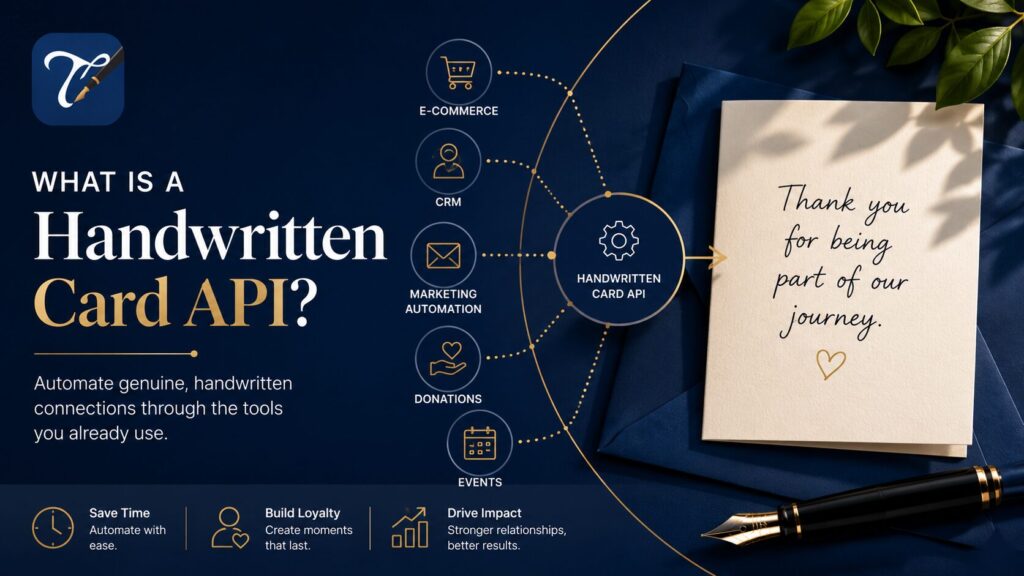
This is exactly the problem that our handwritten card API is designed to solve. They sit at the fascinating intersection of technology and human warmth, enabling businesses, nonprofits, real estate professionals, and individual entrepreneurs to send genuinely personalized, handwritten-style cards automatically, triggered by the very systems and workflows they already use.
Understanding what our handwritten card API is, how it functions, and what it can do for a business requires unpacking both the technical layer and the deeply human purpose behind it.
What Exactly Is Our Handwritten Card API?
An API – Application Programming Interface – is essentially a bridge. It allows two different software systems to talk to each other, share information, and trigger actions without requiring manual human intervention at every step. APIs power countless everyday digital experiences, from the way a ride-sharing app charges your saved credit card to the way an e-commerce confirmation email arrives within seconds of completing a purchase.
Our handwritten card API applies this same logic to physical mail. It connects a business’s existing software ecosystem, CRM platforms, e-commerce tools, marketing automation systems, or custom-built applications, directly to a card creation and mailing service. When a trigger event occurs in the connected system, the API automatically initiates the creation and delivery of a physical, handwritten-style card to the intended recipient.
Thankster, a leading platform in this space, describes the core process clearly: request a Partner API Key, create a template project within the platform, and then utilize API calls that operate on that template to generate and send cards. The result is a seamless flow from digital trigger to physical mailbox, with minimal human effort required after the initial setup.
What makes this particularly powerful is the “handwritten” dimension. These are not sterile, typed, form letters printed on glossy stock. They are cards that replicate the look and feel of genuine handwriting, something that carries enormously different psychological weight than a standard printed mailer.
Why Handwriting Still Matters in a Digital World
Consider the last time you received a handwritten note in the mail. Whether it was a birthday card from a family member, a thank-you from a business you patronized, or even a simple note acknowledging your loyalty as a customer, there is an almost universal emotional response to receiving something written by hand. It signals effort. It signals care. It signals that someone took time specifically for you.
In an era where inboxes overflow with automated emails, and digital ads follow people from platform to platform, the physical handwritten card has become remarkably rare and therefore remarkably impactful. Direct mail in general has experienced a resurgence in effectiveness precisely because the digital world has become so saturated. But handwritten cards, specifically, occupy a tier of perceived effort and sincerity that printed mailers simply cannot replicate.
This is not about nostalgia. It is about the fundamental human response to feeling seen, valued, and appreciated as an individual rather than as an entry in a database. Businesses that understand this principle and find ways to operationalize it gain a genuine competitive advantage in customer retention, referral generation, and brand loyalty.
How Our Handwritten Card API Actually Works: Inside the Thankster System
Taking Thankster as a practical example helps illustrate how these systems function in the real world. The platform is built around the concept of templates and automation layers, allowing users to maintain creative control over their card designs while giving the API the flexibility to personalize and deploy those designs dynamically.
API Templates: The Foundation of Dynamic Personalization
Within Thankster’s ecosystem, there are specific template types designed for API use. These API Templates serve as the blueprint for every card sent through an integration or direct API call. Unlike standard templates used for one-off projects, API templates include specialized tools within the design editor, specifically, the ability to designate “API text” or “API images” fields.
These designated fields are placeholders. When an API call is made, triggered by a purchase, a subscription, a donation, a birthday, or any other event, the API dynamically passes the relevant personalized content into those fields. This means a single template can produce thousands of uniquely personalized cards, each addressed to a different recipient with customized messaging, while maintaining a consistent visual design and handwriting style.
Picture this scenario: an e-commerce brand creates a beautifully designed thank-you card template with a warm, handwritten message area. Every time a customer places an order above a certain value, the connected system triggers a Thankster API call. The card is automatically generated with that specific customer’s name and a personalized note, and it is in the mail within one to two business days, arriving at the customer’s door within the week, entirely without manual intervention from the business team.
Integration Options: Meeting Businesses Where They Already Operate
One of the most practical advantages of a well-designed API is its ability to connect with the tools businesses already rely on. Thankster supports integration with platforms like Zapier and Make, which themselves connect to thousands of other applications. This means that virtually any business workflow, from CRM events to e-commerce triggers to form submissions, can become a catalyst for a physical, personalized card being sent.
Beyond broad integration platforms, Thankster also offers direct integrations with specific tools like Keap, which is widely used in small business and entrepreneurial circles. This kind of purpose-built integration reduces setup friction significantly for businesses already operating within those ecosystems.
For organizations with more sophisticated technical needs, the custom API path offers complete flexibility. A developer can integrate Thankster’s card-sending functionality directly into a custom application, controlling every parameter of when, how, and to whom cards are sent. This is particularly valuable for enterprises managing large customer databases or for SaaS platforms that want to offer handwritten card capabilities as a feature to their own users.
The Range of What Gets Sent: Cards, Formats, and Content
A common misconception about automated handwritten cards is that they must be simple or limited in format. Thankster’s platform demonstrates the opposite. Businesses can send folder cards, flat cards, postcards, or standard letters. For situations requiring inserts – e.g., business cards, gift cards, magnets, or other physical materials – those options are available through direct outreach to the Thankster team.
Content personalization goes beyond just the recipient’s name, even without the API. Thankster’s design editor supports merge fields, allowing variable data to flow into card text dynamically. This could be a customer’s purchase history, a donor’s contribution amount, a real estate agent referencing a specific neighborhood, or any other data point stored in the originating system. The result is a card that feels genuinely written for that specific person rather than a mass-produced piece with a name swapped in.
The platform also incorporates AI-powered tools for content generation. Users who find themselves uncertain about what to write, a surprisingly common challenge even for businesses with strong relationships to maintain, can use AI prompting tools within Thankster to generate appropriate message text for any occasion. Similarly, AI image generation is available for those who want custom visuals on their cards without the need for professional design resources.
Use Cases That Reveal the True Value of Handwritten Card APIs
The practical applications of handwritten card APIs span an impressive range of industries and business contexts. Thankster specifically highlights several verticals where this technology delivers notable results.
Real Estate
In an industry built on relationships, referrals, and local reputation, the ability to automatically send personalized handwritten cards after closings, open houses, or anniversaries gives real estate professionals a distinctive edge. Imagine the impression left by receiving a handwritten congratulations card days after moving into a new home, especially when every other agent in the market is sending a generic email.
Insurance
Insurance relationships are long-term but often feel transactional. Automated handwritten cards for policy anniversaries, renewal periods, or significant life events transform those touchpoints into relationship-building moments that foster genuine loyalty and reduce churn.
Nonprofits
Donor stewardship is one of the most critical, and resource-intensive, aspects of nonprofit fundraising. A handwritten thank-you card, triggered automatically upon receipt of a donation, communicates gratitude in a way that email receipts simply cannot. For organizations where every donor relationship matters, this kind of personalized touchpoint can meaningfully impact retention and recurring giving.
E-Commerce
The post-purchase experience is one of the most underinvested phases of the customer journey in e-commerce. A handwritten card arriving with or shortly after an order creates a brand memory moment, the kind that drives social sharing, word-of-mouth referrals, and repeat purchases. Automated via API, this touchpoint costs a fraction of what it would to execute manually while delivering outsized emotional impact.
Pricing Structures and Getting Started
Thankster’s pricing model reflects the different ways businesses engage with the platform. API and integration orders, which represent the highest volume automated use cases, come with the platform’s lowest per-card pricing, a logical incentive for businesses committing to ongoing automated campaigns. One-off projects carry slightly higher per-card costs, though pre-purchased credit packs offer a discount path for those who want flexibility without a recurring commitment.
Getting started with the Thankster API follows three straightforward steps: requesting a Partner API Key from Thankster, creating an API template project within the platform, and then utilizing the API calls documented in Thankster’s API documentation to begin triggering orders from external systems. The Thankster team is available for direct consultation on both the technical and strategic dimensions of implementation.
The Strategic Principle Behind the Technology
At its core, a handwritten card API is a tool for expressing a principle that has always been true in business and in life: people remember how they were made to feel. Technology has historically made it easier to communicate at scale and harder to communicate with genuine warmth. The handwritten card API represents a meaningful reversal of that trade-off.
By automating the logistics while preserving the emotional authenticity of a handwritten note, platforms like Thankster allow businesses to operate at the scale modern commerce demands without sacrificing the human connection that modern customers increasingly crave. It is not a replacement for genuine relationships, it is infrastructure that makes genuine relationship-building sustainable across hundreds, thousands, or even hundreds of thousands of contacts.
For any business genuinely invested in customer experience, donor relations, client retention, or referral generation, understanding and implementing handwritten card API technology is not a luxury consideration. It is an increasingly essential component of a relationship strategy built to last.
Ready to explore handwritten card automation for your business? Visit Thankster.com to learn more about their API capabilities, pricing, and integration options, or reach out directly to request API documentation and a Developer API Key.