
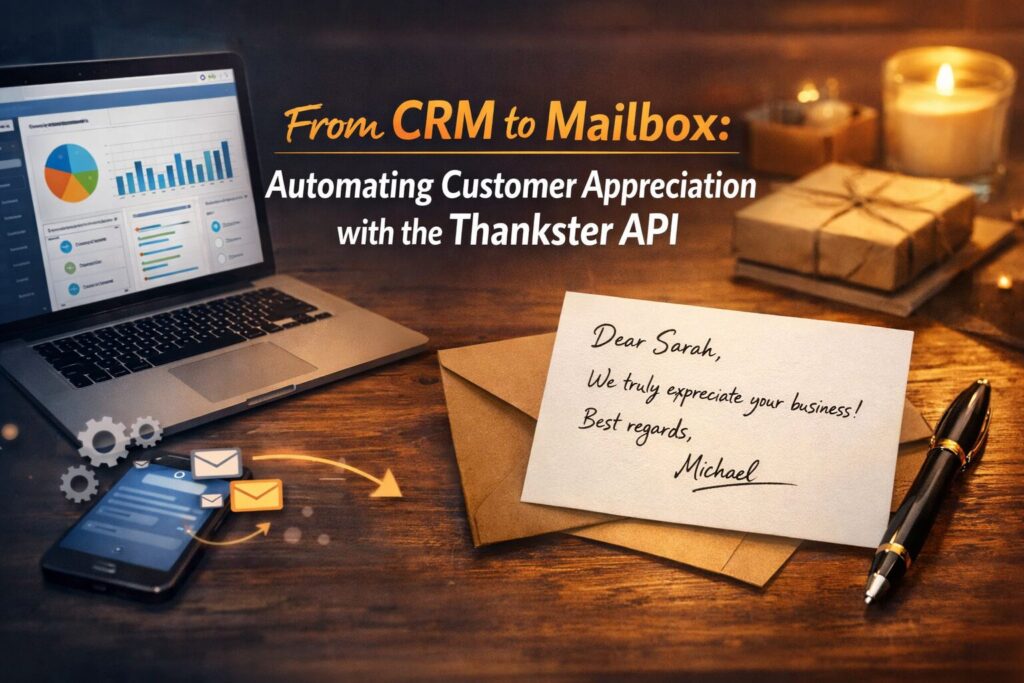
From CRM to Mailbox: Automating Customer Appreciation with the Thankster API
There’s a quiet revolution happening at the intersection of automation and human connection. While most businesses are doubling down on email sequences, push notifications, and in-app messages, the smartest operators are rediscovering something older, warmer, and far more memorable – an actual physical card that arrives in the mail.
Not just any card. A personalized, handwritten-style card that feels like it came from a real person who genuinely thought about the recipient. The kind that sits on someone’s desk for weeks, not in a spam folder.
The challenge has always been scale. Genuine appreciation is hard to automate without losing the soul of the gesture. That’s precisely where the Thankster API changes the equation entirely – allowing businesses to connect their existing CRM and other workflows directly to physical, personalized cards printed and mailed on their behalf.
This is a level of automation capability and flexibility that goes beyond our UI and low code (e.g., Zapier and Make) options.
The Appreciation Gap in Modern Customer Relationships
Think about how most businesses communicate with customers after a purchase. An automated confirmation email arrives instantly. A review request follows two days later. A discount code might show up a week after that. Everything is digital, frictionless, and – if we’re being honest – fleeting and completely forgettable.
There’s nothing inherently wrong with digital communication. But when every touchpoint looks the same, customers stop feeling like individuals and start feeling like entries in a database. The emotional resonance that builds loyalty – the feeling of being seen and valued – quietly erodes.
Now imagine if a customer received a physical card, arriving in an envelope (perhaps with handwritten addressing) with a personalized message referencing their actual experience. The contrast with every other piece of marketing communication they receive would be striking. That contrast is the value. It signals that someone cared enough to do something different.
The Thankster API exists to create exactly that moment – at scale, without sacrificing the authenticity that makes it meaningful.
What the Thankster API Actually Does

At its core, the Thankster API is a bridge between your data and a physical mailbox. Developers and marketing technologists can use it to automate the entire lifecycle of a personalized card – from template selection and message customization to printing and physical delivery – without manual intervention at any stage.
The workflow is elegantly simple:
-
Create a project template inside your Thankster account — this defines the visual design and message structure of your card.
-
Pass contact data through the API, including names, addresses, and any personalization details you want to merge into the message. Images can be passed as well.
-
Trigger card generation via an API call — authenticated with a secure Bearer token — and the system takes over from there.
-
Thankster prints and mails the cards, handling all fulfillment on the backend.
For developers, it is refreshingly clean. There’s no complex configuration, no third-party fulfillment partner to manage, no need to coordinate print runs manually. The entire process is triggered programmatically, which means it can be embedded into existing CRM automation sequences, webhook workflows, or custom business logic.
Connecting Your CRM to the Physical World
The real power of the Thankster API emerges when it’s integrated with a CRM or marketing automation platform. Picture this scenario: a customer completes their fifth purchase, crossing a threshold your system has been tracking. Normally, this might trigger a loyalty email. With Thankster in the workflow, it triggers something far more memorable – a handwritten-style card congratulating them on their loyalty, signed with the name of their account manager or the founder.
This kind of trigger-based card sending can be applied across a remarkable range of business moments:
-
Post-purchase thank-you campaigns — reaching customers within days of a transaction with warmth that email simply can’t replicate.
-
Real estate follow-ups — agents can automate cards for new homeowners, anniversaries, or referral acknowledgments without losing the personal touch that defines the profession.
-
Event outreach — attendees receive a card after a conference, webinar, or in-person event, reinforcing the relationship while the memory is still fresh.
-
Automated gifting campaigns — birthdays, work anniversaries, and customer milestones become opportunities for appreciation rather than calendar items that pass unnoticed.
Each of these use cases shares a common thread: they take a data point that already exists in a CRM — a date, a transaction, a behavior — and transform it into a human moment. The API serves as the translation layer between a database field and an emotional experience.
Personalization at the Heart of Every Card
Automation without personalization is just noise. This is a principle that every experienced marketer understands intuitively, and it’s why the Thankster API’s support for merge fields is so significant.
Merge fields allow card templates to dynamically incorporate recipient-specific information — names, locations, purchase details, referral names, or any other variable your CRM tracks. The result is a card that feels individually crafted, even when hundreds are being generated simultaneously.
The best practice here is restraint. A card that includes someone’s first name, references something genuinely specific to their relationship with the business, and closes with a warm, human sign-off will always outperform a card stuffed with data points. The goal is to feel personal, not personalized in an unsettling way. Keep templates simple and readable, as the Thankster documentation advises – it’s advice grounded in what actually moves people emotionally.
Imagine if a real estate agent sent a card one year after closing that simply said: “It’s been a year since you turned that key for the first time. Hoping your home has been everything you dreamed.” No statistics, no offers, no calls to action. Just acknowledgment. The merge field might only contain the recipient’s first name, but the emotional payload is enormous.
The Broader Trend: Physical Touch in a Digital World

The Thankster API exists within a larger cultural moment. As digital channels become more crowded and attention becomes more scarce, physical communication is experiencing a renaissance in business contexts. The novelty of receiving something tangible has paradoxically increased as digital communication has become the default.
Forward-thinking companies are recognizing that the customer experience doesn’t live entirely on screens. The moments that generate stories – the experiences customers describe to friends, the gestures that turn a satisfied buyer into an enthusiastic advocate – often involve something physical, something unexpected, something that required effort beyond clicking “send.”
By making that physical gesture programmable, the Thankster API democratizes what was once only feasible for businesses with dedicated relationship managers or administrative staff. A solo entrepreneur can now send as thoughtful a card as a Fortune 500 company with a full customer success team.
Getting Started: The Path from API Key to First Card
The onboarding process reflects the same simplicity that characterizes the API itself. Requesting an API key, creating a card template within the Thankster account, and making an initial test call are the three foundational steps. From there, the integration depth is determined by the specific use case – some teams build simple one-click triggers, while others embed the API into complex multi-step automation sequences with conditional logic.
The entry point is intentionally low. A developer comfortable with REST APIs and a marketer with a clear sense of which customer moments matter most can have a functional integration running within a day. The sophistication of what gets built on top of that foundation is limited only by imagination and CRM capability.
Appreciation as Competitive Advantage
In markets where products and prices are increasingly comparable, the way a business makes its customers feel becomes a primary differentiator. Appreciation – genuine, specific, well-timed appreciation – is one of the most powerful emotional levers available to any business.
The Thankster API doesn’t automate away the humanity of gratitude. It removes the logistical barriers that prevent businesses from expressing that gratitude consistently and at meaningful scale. The warmth in the message, the thoughtfulness of the timing, the decision to reach someone in their physical world rather than their digital inbox – those remain entirely human choices.
What changes is the ability to act on those choices for every customer, at every milestone, without the process breaking down under the weight of operational complexity. From CRM data to a card on someone’s kitchen counter, the journey is now a matter of a well-crafted API call and a genuine desire to say thank you or convey other impactful messages.
That combination – technology in service of human connection – is what makes the Thankster API not just a developer tool, but a philosophy about how businesses and customers ought to relate to one another.