
There is something deeply human about handwriting. Long before printing presses, digital screens, or automated marketing campaigns, the curve of a pen on paper was the most intimate form of communication a person could offer. It said: I took time for you. You mattered enough for this.
That emotional truth has never changed – even as the world around it has transformed entirely. In an era where inboxes overflow with automated emails and social feeds scroll endlessly with algorithmic content, a handwritten note still stops people cold. It creates a pause. A moment of genuine surprise. And in that pause lives an extraordinary marketing opportunity that forward-thinking brands are only beginning to fully understand.
But here is what most conversations about handwritten communication miss entirely: it is not just the idea of handwriting that creates emotional impact. It is the quality of the handwriting design itself. From character variation to natural alignment, from font personality to authentic feel – the technical craft behind handwriting design is what separates a note that moves someone and a note that merely mimics the idea of moving someone.
The Psychology Behind Handwritten Communication

Human beings are wired to detect authenticity. Decades of social psychology and communication research have consistently pointed to the same truth: people respond not just to what they receive, but to what that thing signals about the sender’s intentions.
When someone receives a handwritten note in the mail, the brain processes it differently than a printed letter. It triggers associations tied to personal relationships – the birthday cards from grandparents, the thank-you notes after job interviews, the love letters tucked into coat pockets. These associations are powerful and largely unconscious. The moment a customer holds what appears to be a genuinely handwritten piece of mail, they are emotionally repositioned from transaction partner to valued individual.
This repositioning is not a small shift. It fundamentally alters how they interpret every word on that page. A discount offer in a standard printed mailer reads as a corporate incentive. The same offer written in warm, natural script reads as a personal gesture. The information is identical. The feeling is completely different.
And feeling, ultimately, is what drives decisions.
Why Font Design in Handwriting Is More Complex Than It Appears
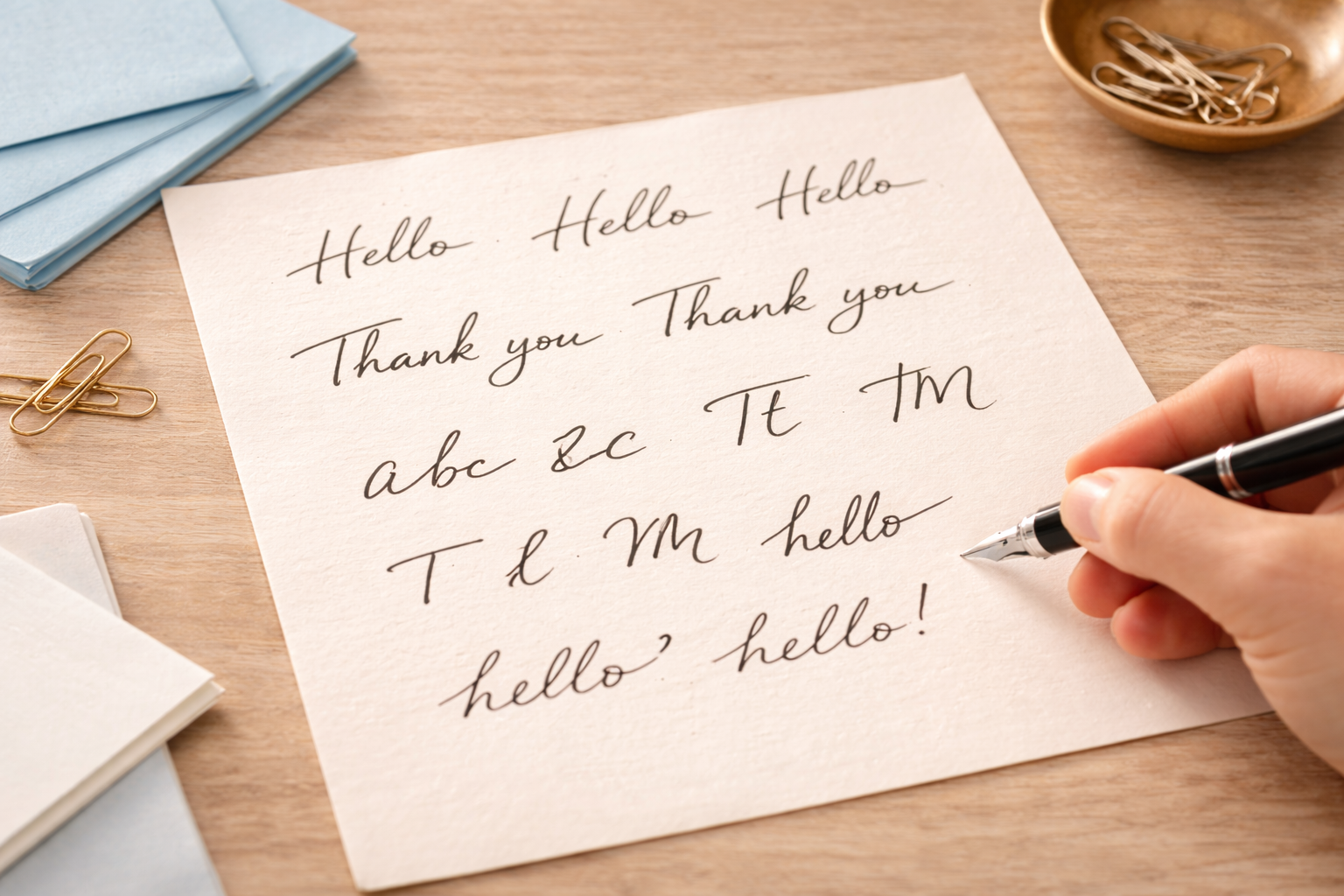
Imagine if you picked up a “handwritten” note and every letter ‘e’ looked identical – the exact same angle, the exact same loop, the exact same pressure. Even if you could not consciously identify what felt off, something would register as artificial. Your brain, trained through a lifetime of reading real human handwriting, would sense the mechanical repetition and quietly flag the note as inauthentic.
This is precisely why handwriting design is far more nuanced than simply creating a stylized font. A truly convincing handwriting experience depends on character variation – the subtle, natural inconsistencies that occur when a real human writes the same letter multiple times in succession. The slight tilt of one ‘a’ versus another. The way a capital ‘T’ connects differently depending on the letter that follows it.
Thankster, a platform dedicated to authentic handwriting technology for direct mail, has built its entire foundation around this principle. Their approach recognizes that creating natural-looking mail pieces goes well beyond digitizing a font style. It requires careful attention to how characters assemble within words, how alignment flows naturally between letters and sentences, and how the overall composition feels when read as a continuous, human-generated piece of correspondence.
This level of technical precision in handwriting design is what makes the difference between a customer who feels genuinely touched and a customer who senses they have been marketed to with a gimmick.
The Spectrum of Handwriting Personality
Every handwriting style carries its own emotional signature. Consider the range of personalities that different scripts project:
-
Rounded, looping scripts feel warm, approachable, and personal – ideal for customer appreciation notes or relationship-building campaigns in industries like real estate, insurance, or nonprofit outreach.
-
Upright, clean cursive projects professionalism with a personal touch – well-suited for financial services firms or healthcare providers who want to balance authority with genuine care.
-
Casual, slightly irregular print styles communicate friendliness and approachability – perfect for eCommerce brands or consumer goods companies building loyalty with everyday customers.
-
Elegant, flowing scripts evoke luxury and exclusivity – the language of high-end hospitality, premium retail, or boutique service brands.
Of course this is subjective to some degree, and subject to personal taste. But the strategic selection of a handwriting style can be, in the end, a branding decision. It communicates values and personality before a single word is consciously read. This is why platforms offering extensive handwriting libraries – Thankster maintains a catalog of over 100 handwriting styles (and also lets you create your own) – provide genuine strategic value. The right script is not just aesthetically pleasing; it is brand-aligned storytelling at the most fundamental visual level.
Custom Handwriting: The Ultimate Personalization Layer
Picture this scenario: a regional insurance agency wants to send follow-up notes to every client after a policy renewal. They want the notes to feel as though the actual agent – a person the client has met, spoken with, and built a relationship with – personally wrote each one.
If you want to create your own font (especially useful for consumer mailings, like weddings), the process is designed to be accessible: fill out our Handfont form, run it through the software, and deploy it across mailers at scale. The outcome is something remarkable – the genuine warmth of personal handwriting, delivered at the volume modern business demands.
In industries built on trust and personal relationships – real estate, financial planning, customer retention campaigns, nonprofit donor stewardship – this capability is not a novelty. It is a competitive advantage.
Handwriting in the Context of Drip Campaigns and Automation
One of the most compelling evolutions in direct mail marketing is the integration of handwriting design into automated, multi-touch communication sequences. The concept of a handwritten drip campaign – a series of personalized, handwritten notes triggered by customer behaviors or milestones – represents a powerful convergence of emotional marketing and operational efficiency.
Imagine if every new customer received a genuinely handwritten welcome note three days after their first purchase. Then a handwritten check-in card thirty days later. Then a personalized anniversary note on the one-year mark of their relationship with the brand. Each note, written in a consistent, carefully chosen handwriting style, arriving in a physical mailbox that receives a fraction of the attention most digital channels compete for.
The cumulative effect of this kind of touchpoint strategy is profound. It builds a sense of ongoing personal relationship rather than transactional history. Customers who feel individually recognized are not just more loyal – they become advocates. They tell the story of the company that actually took the time to write to them, in a world where no one does anymore.
For eCommerce brands working to build retention in fiercely competitive markets, or for nonprofit organizations stewarding donor relationships across large constituencies, automated handwriting campaigns represent one of the highest-return personalization strategies available.
Trends Shaping the Future of Handwriting in Marketing
Several converging trends are accelerating the relevance of handwriting design as a marketing discipline:
Digital Fatigue Is Real and Growing
Consumers have grown increasingly numb to digital communication. Open rates for email continue their long decline. Social media advertising faces mounting skepticism. In this environment, physical mail – and particularly handwritten physical mail – benefits from a stark contrast effect. It is the quiet voice in a room full of shouting, and quiet voices get heard.
Personalization Expectations Have Reached a New Ceiling
Customers now expect brands to know them individually. First-name personalization in email subject lines barely registers. The bar has risen dramatically, and handwritten correspondence clears that bar in a way few digital tactics can match. It does not just say the customer’s name – it writes it, in ink, on paper, and sends it to their door.
The Tactile Experience Is a Differentiator
Research into sensory marketing has consistently found that physical, tactile experiences create stronger memory encoding than purely visual or auditory ones. A handwritten card that someone holds, turns over, and places on their desk creates a fundamentally different cognitive and emotional imprint than an email that lives in a folder they may never open again.
Authenticity as Brand Currency
In an age where consumers are extraordinarily sensitive to corporate inauthenticity, the brands that find credible ways to express genuine care earn disproportionate loyalty. Handwritten correspondence, executed with the technical quality that makes it feel truly personal, is one of the most credible authenticity signals available to a brand.
Practical Tips for Leveraging Handwriting Design Effectively
Match the Script to the Moment
Different communications serve different emotional purposes. A prospecting note for a real estate agent should feel warm and approachable. A high-value client appreciation letter from a wealth management firm should feel refined and considered. Invest time in selecting or creating a handwriting style that emotionally matches the specific communication goal.
Prioritize Natural Variation Over Perfection
Counterintuitively, slight imperfection is an asset in handwriting design. The slight inconsistencies that make handwriting feel human are precisely what create emotional authenticity. When evaluating handwriting technology or fonts, look for evidence of character variation – multiple versions of each letter – rather than pixel-perfect uniformity.
Consider Creating a Custom Font for Key Relationships
For businesses where the personal brand of a specific individual – a founder, a lead advisor, a primary relationship manager – drives customer trust, investing in a custom handwriting font derived from that person’s actual script is worth serious consideration. The authenticity premium is significant and sustainable.
Integrate Handwriting Into a Broader Touchpoint Strategy
Handwritten notes are most powerful when they arrive at emotionally meaningful moments: after a first purchase, following a service resolution, on a customer anniversary, or at a milestone in a long-term relationship. Mapping these moments and building automated triggers around them turns handwriting from a periodic tactic into a systematic relationship-building engine.
Test Templates Across Your Customer Segments
Different customer segments may respond differently to different handwriting styles, tones, and message lengths. Use available template libraries – Thankster provides a browsable collection of public templates – to experiment with different approaches and observe what resonates most deeply with different audience groups.
The Deeper Truth About Handwriting and Human Connection
There is a reason that throughout history, across every culture that developed written language, the handwritten personal letter was considered among the most meaningful forms of communication one person could offer another. It carried proof of time invested, attention given, and genuine regard expressed.
That meaning has not diminished. If anything, in a world of instant, effortless digital communication, the deliberateness that handwriting implies has become more valuable, not less. When a customer receives a note that looks and feels genuinely handwritten – one where the characters vary naturally, the alignment flows with human authenticity, and the script carries a personality matched to the moment – they receive something far more than information.
They receive evidence that someone, somewhere in the organization that sent it, thought of them as a person worth writing to.
In the arithmetic of customer loyalty, that evidence is worth more than almost any other marketing investment a brand can make. The science of handwriting design – character variation, natural alignment, script personality, authentic reproduction – is ultimately in service of this single, irreducibly human truth.
Connection is what people remember. And handwriting, designed with craft and deployed with intention, is one of the most powerful tools for creating it.