
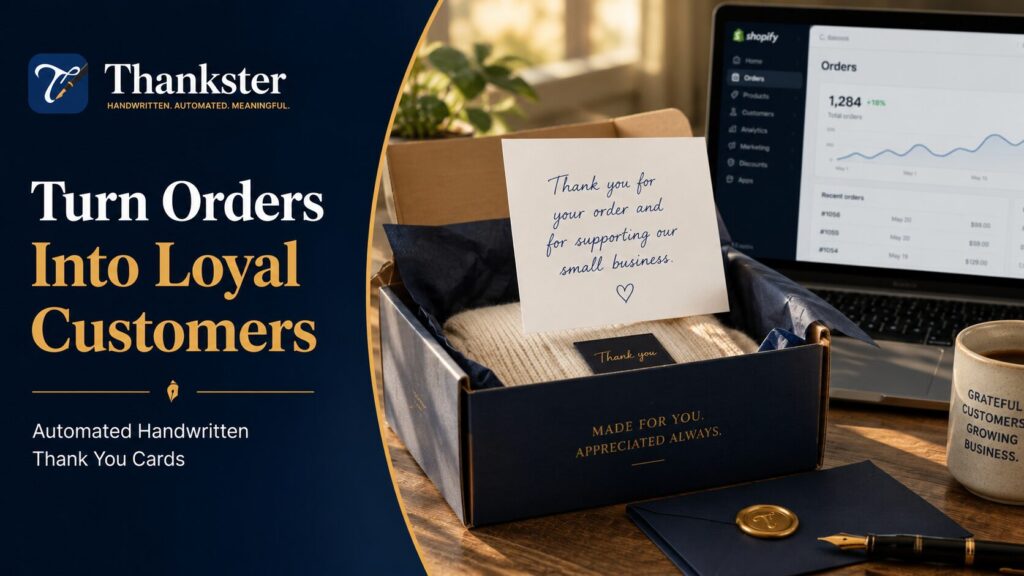
How Shopify Stores Use Thankster to Increase Customer Retention
Meta Description: Discover how Shopify stores are leveraging Thankster’s automated, handwritten thank you cards to boost customer retention, inspire loyalty, and stand out in a competitive eCommerce landscape.
Primary Keywords: Shopify customer retention, Thankster Shopify integration, handwritten thank you cards eCommerce, automated thank you cards Shopify, personalized customer appreciation cards
The Quiet Crisis in eCommerce: Winning Customers Is Only Half the Battle
There is a persistent tension at the heart of every Shopify store. Merchants invest considerable resources – in advertising, SEO, product development, and user experience – to bring customers through the proverbial door. Yet once a purchase is made, many stores essentially go silent. The transaction ends, the confirmation email fires automatically, and the customer moves on with their day, likely without a second thought about returning.
This is the quiet crisis of modern eCommerce: acquiring customers has become an art form, but retaining them remains stubbornly difficult. The economics of customer retention are well-established in business literature. Keeping an existing customer requires a fraction of the investment that acquiring a new one demands, and loyal customers tend to spend more, return more frequently, and refer others more readily. Yet despite understanding this principle, many Shopify merchants continue to pour disproportionate energy into the top of the funnel while the bottom quietly leaks.
The question, then, is not whether customer retention matters. It clearly does. The more pressing question is: what actually moves the needle in a world where every inbox is flooded with promotional emails, retargeting ads follow shoppers across the internet, and discount codes have become so ubiquitous they barely register anymore?
The answer, perhaps surprisingly, may lie in something far older and more human than any digital marketing tactic: a handwritten note.
Why Handwritten Cards Cut Through the Noise
Consider the experience of receiving physical mail. In an era when the average person processes dozens of digital communications daily, a physical card or note arriving in the mailbox carries an entirely different emotional weight. There is something inherently human about the act of handwriting a message to someone. It communicates that time was spent, that thought was given, and that the recipient matters enough to warrant that investment.
Now imagine receiving such a card after purchasing from an online store. The contrast with the typical post-purchase experience – a templated email confirmation, perhaps a follow-up asking for a review – is dramatic. The card does not just convey information; it conveys care. And in a highly competitive industry like eCommerce, that distinction is extraordinarily powerful.
This is precisely the insight that underpins Thankster, a platform that enables Shopify merchants and other eCommerce businesses to automate the sending of personalized, handwritten-style thank you cards to their customers. Thankster bridges the gap between the efficiency of digital automation and the warmth of genuine human connection, producing cards that look and feel as though they were written by hand – because the technology is specifically optimized to replicate authentic human handwriting, including subtle variations in letterforms that make each card feel personal rather than printed.
The Thankster and Shopify Integration: How It Actually Works
For Shopify merchants, one of the most compelling aspects of Thankster is its integration flexibility. The platform connects directly with Shopify, and merchants can also leverage a Zapier integration to access a wide range of automation triggers. These triggers include:
-
New Customer – Send a welcome card the moment someone creates an account
-
New Order / New Paid Order – Trigger a thank you card following a completed purchase
-
New Abandoned Cart – Reach out to customers who left without completing checkout
-
Updated Customer / Updated Order – Respond to changes in customer behavior or order status
-
New Canceled Order – Reach out with grace and goodwill when an order is canceled
Each of these triggers represents a meaningful touchpoint in the customer journey – moments where a thoughtful, personalized card can shift perception, rebuild trust, or deepen loyalty. The automation ensures that no customer falls through the cracks due to human oversight or operational busyness. Every relevant event produces a corresponding, personalized response, delivered through physical mail.
Thankster also pulls data directly from the Shopify platform – customer names, order details, purchase history, shipping addresses – to ensure that each card feels genuinely tailored rather than generic. A card that references a customer by name and acknowledges their specific purchase carries far more emotional resonance than a form letter, and that resonance is what drives the behavioral outcomes merchants care about most.
data:
Specific Use Cases That Drive Retention and Revenue
Order Confirmation Thank You Cards
The most foundational use case is also one of the most impactful. After a customer places an order on a Shopify store, Thankster automatically generates and mails a personalized thank you card expressing genuine gratitude for the purchase. This creates a positive post-purchase experience that most eCommerce stores fail to deliver in any meaningful way. The customer who receives a physical card is reminded that there is a real business – and real people – behind the transaction. That reminder is the first step toward building a lasting relationship rather than a one-time transaction.
Abandoned Cart Recovery
Abandoned carts represent one of the most frustrating and costly phenomena in eCommerce. A potential customer browsed, selected products, and came within steps of completing a purchase – then walked away. Email sequences exist to address this, but their effectiveness has diminished as inboxes have grown more crowded.
Thankster offers a markedly different approach. When a cart is abandoned, the platform can trigger the sending of a handwritten card that acknowledges the interest, perhaps includes a special discount or incentive, and gently invites the customer to return. A physical card arriving days after the browsing session, warm in tone and personal in feel, creates a touchpoint that is difficult to ignore and even harder to forget.
Upsell and Cross-Sell Cards
Customer purchase history is a goldmine of insight, and Thankster enables merchants to act on that insight in a human, non-intrusive way. Imagine a customer who purchases a particular type of product from a Shopify store. Thankster can be set up to send a thank you card that acknowledges that specific purchase and includes a thoughtful, personalized recommendation for complementary products. This approach to upselling feels advisory rather than pushy, which makes it far more likely to be well-received and acted upon.
Including a promotional offer or discount code within the card creates an additional incentive for repeat purchases, effectively turning a thank you gesture into a revenue-generating touchpoint – without the transactional awkwardness that often accompanies overtly commercial communications.
Recognizing Repeat Customers
Loyal customers are the lifeblood of any thriving eCommerce business. When a customer reaches a certain milestone – a specific number of purchases, a cumulative spending threshold, or an anniversary of their first order – Thankster can automatically send a card that acknowledges and celebrates that loyalty. This kind of recognition communicates something powerful: that the business is paying attention, that the customer’s continued support has been noticed, and that the relationship is valued beyond its transactional dimensions.
The psychological impact of being recognized should not be underestimated. Humans have a deep-seated need to feel seen and appreciated. Businesses that meet this need build emotional connections that are remarkably durable, even in the face of competitive alternatives.
Thanking Customers for Product Reviews
Product reviews are among the most valuable assets an eCommerce store can accumulate. They influence purchase decisions, build social proof, and improve search visibility. Yet many merchants fail to close the loop when a review is submitted. Thankster enables stores to automatically send a thank you card when a customer leaves a review, acknowledging their contribution and reinforcing their engagement with the brand. This small act of recognition encourages ongoing participation and signals that customer feedback is genuinely valued.
Birthday and Anniversary Cards
By leveraging customer data captured in Shopify, Thankster can automate the sending of personalized cards on customers’ birthdays or on the anniversary of their first purchase. These are moments of genuine personal significance, and a brand that remembers them – and marks them with a handwritten card – occupies a very different place in a customer’s mind than one that simply sends promotional emails.
Loyalty Program Milestone Cards
For Shopify stores with loyalty programs, Thankster integrates seamlessly into the milestone recognition process. When a customer reaches a new loyalty tier or unlocks a reward, a card acknowledging that achievement and expressing gratitude for their continued support can be automatically mailed. These cards transform loyalty programs from purely transactional structures into emotionally resonant experiences – a meaningful distinction in a market where loyalty programs have become commonplace.
Holiday and Seasonal Greeting Cards
Seasonal touchpoints offer valuable opportunities to stay connected with customers outside of the typical purchase cycle. Thankster enables Shopify merchants to automate the sending of personalized holiday or seasonal cards, conveying well wishes, exclusive promotions, or simple expressions of appreciation. These communications reinforce the relationship during periods when customers are often making purchase decisions – but they do so in a way that feels warm and personal rather than commercially opportunistic.
The Compounding Effect: Loyalty, Referrals, and Long-Term Revenue
The individual use cases described above each carry their own value, but their cumulative effect across a customer relationship is where the real power of Thankster becomes apparent. When customers receive thoughtful, personalized physical cards at multiple meaningful points in their journey – after their first purchase, when they reach a loyalty milestone, on their birthday, when they leave a review – the brand occupies an increasingly prominent and positive place in their lives.
This emotional presence translates into tangible business outcomes. Customers who feel genuinely valued are more likely to return for subsequent purchases. They are more likely to choose a familiar, trusted brand over a new competitor, even when the new competitor offers a marginally lower price. And critically, they are more likely to recommend the brand to friends and family – generating the kind of word-of-mouth referrals that no advertising budget can replicate in terms of credibility and conversion.
Thankster’s own documentation articulates this cycle with clarity: when clients receive a thank you note, they are more likely to be inspired to stay loyal, and satisfied customers are more likely to refer others to the store. The platform essentially creates a virtuous cycle – investment in customer appreciation generates loyalty, loyalty generates referrals, and referrals generate new customers who, if treated with the same care, become loyal in turn.
Differentiation in a Crowded Market
It is worth pausing to consider the competitive landscape that Shopify merchants navigate. The barriers to entry in eCommerce have never been lower, which means competition has never been fiercer. Price competition is a race to the bottom. Digital advertising is expensive and increasingly commoditized. Product differentiation is difficult to sustain as manufacturers and suppliers serve multiple competing stores simultaneously.
In this environment, the customer experience itself becomes the most sustainable competitive advantage. And within the customer experience, the moments that create the deepest impressions are often those that feel least expected – the gestures of care and appreciation that go beyond what the customer anticipated.
A handwritten thank you card is precisely such a gesture. Most competitors are not sending them. Most are relying on automated emails, social media retargeting, and loyalty point systems that have become so standard they barely register. A physical card – personalized, warm, arriving in the actual mailbox – is different in kind, not just degree. It is a signal that a business genuinely values its customers as people, not merely as revenue sources.
The Practical Case: Automation, Authenticity, and Affordability
A natural concern with any initiative centered on personalization and human touch is scalability. Handwriting individual notes for every customer is simply not feasible for most businesses beyond a very small scale. This is precisely where Thankster’s automation capabilities resolve what would otherwise be an intractable trade-off between personalization and efficiency.
Thankster automates the mailing of personalized, handwritten-style cards, saving significant time and money while maintaining the authentic feel of a genuinely personal gesture. The platform’s technology is specifically optimized to produce authentic-looking human handwriting – varying individual character instances in ways that mirror natural handwriting variation – so that recipients experience the card as a personal communication rather than a printed form letter. High-quality card stock reinforces this impression.
The consistency that automation provides also addresses a subtler but important operational challenge:data: the risk that some customers receive cards while others do not, simply due to human error or bandwidth constraints. With Thankster handling the process systematically, every qualifying customer receives the appropriate card within the appropriate timeframe, ensuring that the retention strategy operates reliably at scale.
Thankster offers both bulk and plan pricing options designed to be highly affordable relative to the cost of handwriting cards manually – and genuinely economical when considered against the lifetime value of the customers being retained. The ROI case is compelling: a modest investment in personalized card sending can yield meaningful improvements in repeat purchase rates, average order values, and referral volumes.
A Strategic Perspective: Rethinking Post-Purchase Communication
The broader lesson that Thankster’s approach teaches is one about the nature of customer relationships in eCommerce. Transactions are the mechanism through which value is exchanged, but they are not the foundation on which lasting customer relationships are built. That foundation is made of trust, recognition, and genuine appreciation – qualities that digital channels struggle to convey with the warmth and authenticity that physical, handwritten communication naturally carries.
Shopify merchants who integrate Thankster into their retention strategy are, in effect, making a deliberate choice to invest in relationships rather than merely transactions. They are choosing to see their customers as individuals worthy of personal acknowledgment, not simply as data points in a conversion funnel. And in doing so, they are building the kind of customer loyalty that compound over time into a genuinely durable competitive advantage.
The mechanics of the integration are straightforward. The investment is modest. The differentiation is real. And the impact on customer retention – measured in repeat purchases, referrals, and the quiet, enduring loyalty of customers who feel genuinely valued – can be substantial.
For Shopify merchants serious about retention, the question worth asking is not whether handwritten thank you cards can make a difference. The answer to that question is clear. The more useful question is: how many customer relationships are being underserved right now, and what would it mean for the business if even a fraction of those customers felt genuinely appreciated?
Thankster exists to answer that question in the most personal way possible – at scale, automatically, and with the kind of human warmth that no email template has ever been able to replicate.