
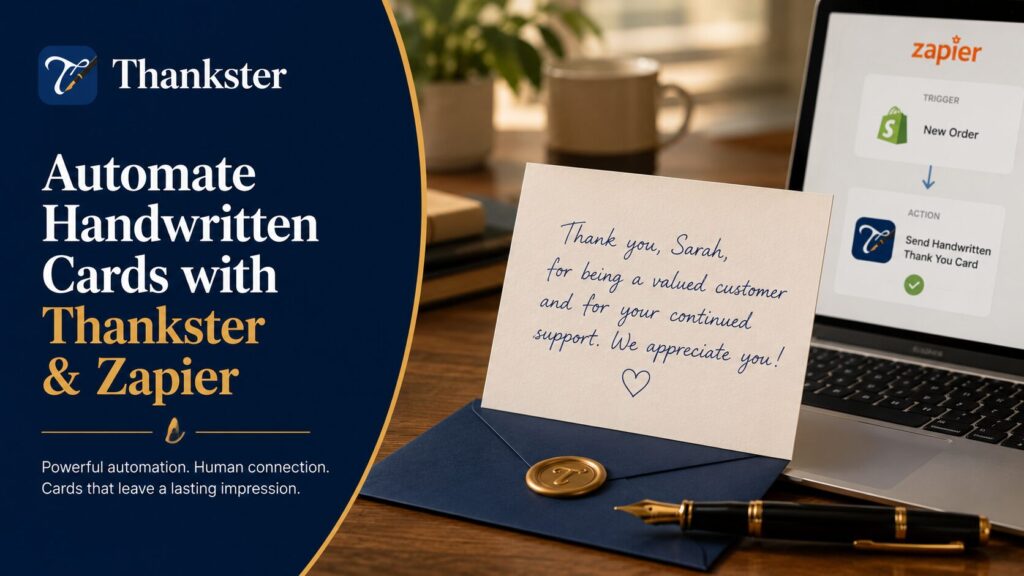
How to Automate Handwritten Cards with Thankster and Zapier: The Complete Guide to Scaling Personal Touch
There is a quiet tension at the heart of modern business communication. On one hand, technology has made it easier than ever to reach thousands of people simultaneously. On the other, those very tools have created a culture of inbox fatigue, where messages blur together into an undifferentiated stream of noise. Against this backdrop, something remarkable has happened: the handwritten card has become one of the most powerful relationship-building tools available to businesses and individuals alike.
The challenge, of course, has always been scale. Handwriting a card to one loyal customer feels meaningful. Handwriting cards to five hundred feels impossible. This is precisely where Thankster steps in – and where its integration with Zapier transforms a beautiful idea into a fully executable business strategy.
The Psychology Behind Handwritten Communication
Before diving into the mechanics of automation, it is worth pausing to understand why handwritten cards hold such disproportionate emotional weight. In a world saturated with digital messages, a physical card arriving in someone’s mailbox carries an implicit message before a single word is read: someone took time for this. That perceived effort is the currency of genuine connection.
Research into relationship-building and consumer behavior consistently affirms that tangible, personalized gestures outperform digital equivalents when it comes to emotional resonance and long-term loyalty. Imagine a scenario where two customers receive the same thank-you message – one via email, one via a handwritten card. The card recipient is far more likely to remember the gesture days, weeks, and even months later. The card recipient is also far more likely to speak about the experience to others.
This is not sentimentality. It is strategy. And Thankster, with its automated handwriting technology, has found a way to preserve that emotional authenticity while solving the problem of scale entirely.
What Thankster Actually Does
Thankster is a platform that produces authentic looking handwritten cards and mails them on behalf of businesses and individuals. The handwriting is created using proprietary technology that replicates the subtle imperfections and natural flow of human penmanship, making each card feel genuinely personal rather than machine-produced.
What elevates Thankster beyond a simple card-sending service is its infrastructure for automation and integration. The platform supports connections with a wide ecosystem of applications, from CRM platforms and e-commerce tools to marketing automation systems and spreadsheet-based triggers. The result is a system where handwritten cards can be sent automatically in response to real-time events – a purchase, a milestone, a subscription renewal, a birthday – without requiring manual intervention at each step.
Thankster’s integration partners include platforms such as Zapier, Make (formerly Integromat), Integrately, Pabbly Connect, Albato, Workato, Latenode, Konnectify, and viaSocket, along with direct integrations for platforms like Shopify, NationBuilder, Infusionsoft, and Google Sheets. Each of these tools serves as a bridge, allowing Thankster to receive trigger signals from virtually any application and respond by dispatching a handwritten card.
Why Zapier Is the Ideal Starting Point
For most businesses beginning their automation journey, Zapier represents the most accessible and widely understood entry point. Zapier is a no-code automation platform that connects thousands of applications through simple trigger-action workflows known as “Zaps.” Its appeal lies in its breadth – it supports connections with tools ranging from Salesforce and HubSpot to Gmail, Typeform, WooCommerce, and far beyond.
When Zapier is connected to Thankster, the implications are significant. Any event that can be captured as a Zapier trigger can potentially initiate the sending of a handwritten card. Picture this scenario: a contact in a CRM reaches a certain deal stage, a customer completes a purchase above a specific threshold, or a subscriber marks their first anniversary with a service. All of these moments can be configured to automatically trigger a personalized handwritten card without a single person needing to press send.
The beauty of Zapier’s architecture is that it does not require technical expertise. The visual workflow builder allows non-developers to construct sophisticated automations with logical ease. Setting up a Thankster integration via Zapier typically involves selecting Thankster as the action app, authenticating the account, choosing a pre-configured card template, mapping recipient data fields from the trigger app, and activating the Zap. From that point forward, the workflow runs independently.
Step-by-Step: Building a Thankster-Zapier Workflow
1. Establish a Thankster Template
Every automated card campaign begins with a well-crafted template inside the Thankster platform. Templates define the card’s message, the handwriting style, the card design, and any variable fields that will be personalized dynamically (such as a recipient’s first name or a specific reference to their interaction with the business). Investing time in this step is essential – the template is the voice of the communication, and it should feel warm, specific, and human even as it scales.
2. Identify the Trigger Event in the Source Application
The next step involves deciding which event in an existing tool should initiate a card. Common examples include:
- A new customer completing their first purchase in Shopify or WooCommerce
- A contact reaching a new lifecycle stage in a CRM such as Salesforce or HubSpot
- A donor completing a gift in a nonprofit management platform
- A client signing a contract or onboarding document
- A subscriber’s birthday or membership anniversary captured in a Google Sheet
The key principle here is intentionality. The most effective automated card programs are not those that send cards frequently, but those that send cards at precisely the right emotional moment. Timing transforms a generic gesture into a memorable one.
3. Connect the Applications in Zapier
Within Zapier, the workflow is constructed by selecting the trigger app and the specific trigger event, then selecting Thankster as the action app. Zapier’s interface guides users through authenticating both accounts and mapping the data fields – ensuring that each card sent draws the correct recipient name, mailing address, and any personalization variables from the source application.
Thankster’s team is also available for support during setup, which makes the process approachable even for businesses without dedicated technical resources. For more complex multi-step workflows – such as sending a card, waiting a defined period, and then triggering a follow-up action – Zapier’s multi-step Zap functionality accommodates this additional sophistication.
4. Test Before Activating
Before activating any automation, it is advisable to run test scenarios through the workflow. Zapier provides testing tools that allow users to simulate trigger events and verify that data maps correctly to the Thankster template. Reviewing a test output ensures that names are spelled correctly, addresses are formatted properly, and the card message reads naturally with the personalization variables filled in. A card that arrives with a blank name field or an awkward sentence due to a formatting error undermines the very authenticity the system is designed to create.
Expanding Beyond Zapier: The Broader Integration Ecosystem
While Zapier serves as an excellent starting point, Thankster’s integration ecosystem extends considerably further for businesses with more specialized needs or using other tools.
Make (formerly Integromat) offers a more visually complex and arguably more powerful workflow builder, with robust free-tier access and deep integration with platforms like HubSpot. For teams managing intricate multi-branch workflows, Make provides a level of control that suits more technically experienced operators.
Infusionsoft (now Keap) integration allows marketing automation and CRM triggers to flow directly into Thankster card campaigns, making it a powerful combination for small business owners running complex nurture sequences who want to include physical mail as a channel within those sequences.
Google Sheets integration opens a uniquely flexible use case. For organizations that maintain contact data in spreadsheets – whether for birthday tracking, event invitations, or milestone recognitions – Thankster can be triggered either manually or automatically based on sheet data. Nonprofit organizations, in particular, find this approach invaluable for donor stewardship programs where personalized acknowledgment is a core relationship-maintenance strategy.
NationBuilder integration makes Thankster especially relevant for political campaigns, community organizations, and advocacy groups that rely on constituent relationship management and want to extend outreach beyond digital channels.
Newer platforms in the ecosystem – including Albato, Latenode, Konnectify, and viaSocket – extend accessibility even further by offering no-code or low-code options with competitive pricing and user-friendly interfaces. Latenode, in particular, combines simplicity with AI-powered capabilities that make it well-suited for teams exploring more intelligent, conditional automation logic.
Strategic Applications Across Industries
The versatility of Thankster’s integration ecosystem means its applications span virtually every sector where relationships matter – which is to say, every sector.
In real estate, agents can configure automations to send handwritten cards at key milestones: when a client first views a property, when a deal closes, and on the anniversary of a home purchase. These touchpoints build the kind of ongoing relationship that generates referrals long after a transaction concludes.
In financial services, advisors can use CRM integrations to trigger cards when clients reach significant life milestones – retirement, a child’s college enrollment, a major investment anniversary. In an industry where trust is the foundational currency, handwritten acknowledgment of these moments communicates a level of attentiveness that digital communication simply cannot match.
In nonprofit donor retention, handwritten thank-you cards sent immediately after a contribution – automatically triggered via a donation management platform or Google Sheet – dramatically outperform email acknowledgments in terms of donor retention rates. The act of a physical card communicates that the organization values the donor as a person, not merely as a transaction.
In eCommerce, the post-purchase experience has become a critical differentiator. With direct Shopify integration, brands can automate cards that feel artisanal and personal even as volume scales. This approach is especially effective for building repeat purchase behavior and encouraging organic word-of-mouth referrals.
Practical Tips for Maximizing Automation Effectiveness
Prioritize quality over frequency. An automated system that sends cards at every interaction can dilute the sense of specialness that makes handwritten communication effective. Identify the two or three highest-impact moments in a customer or donor journey and concentrate automation there.
Write templates as though writing to one person. The goal of personalization variables is not simply to insert a name, but to make the reader feel genuinely seen. Templates should be conversational, warm, and specific enough to feel intentional without being generic.
Review templates periodically. As brand voice evolves or seasonal relevance shifts, templates should be revisited. An automation that runs untouched for years can begin to feel dated or misaligned with current messaging.
Align automation triggers with emotional peaks. The most powerful moments to send a card are those where the recipient is already emotionally engaged – immediately after a significant purchase, on a recognized anniversary, following a meaningful interaction. Cards sent at these peaks amplify a feeling that already exists rather than attempting to create one from scratch.
Leverage Thankster’s support resources. For organizations new to automation, Thankster’s team is available to assist with setup across its integration options. Taking advantage of this support at the outset reduces friction and ensures that workflows are configured correctly from the start.
The Future of Relationship Automation
The broader trend in business communication is moving simultaneously in two directions that might initially appear contradictory. Automation is becoming more pervasive, more sophisticated, and more deeply embedded in organizational workflows. At the same time, audiences are becoming more discerning, more resistant to impersonal outreach, and more responsive to genuine, human-feeling communication.
Platforms like Thankster represent the resolution of this apparent contradiction. They demonstrate that automation and authenticity are not mutually exclusive – that the right infrastructure can preserve the emotional weight of a handwritten gesture even as it operates at scale. The handwriting is real. The ink is real. The card arrives in a physical mailbox. The automation is simply the mechanism that ensures the right person receives that real experience at the right moment.
data:
For businesses navigating an increasingly noisy communication landscape, this combination of Thankster and Zapier – and the broader integration ecosystem surrounding them – offers something genuinely valuable: a systematic way to make people feel remembered. In the long arc of relationship building, that is not a small thing. It is, in many respects, everything.
Thankster integrates with Zapier, Make, Integrately, Pabbly Connect, Albato, Workato, Latenode, Konnectify, viaSocket, Shopify, NationBuilder, Infusionsoft, and Google Sheets. Pricing is based on the cards sent, with flexible plans available to suit businesses of every size. Visit Thankster’s integrations page to explore options and connect with their team for personalized setup guidance.