
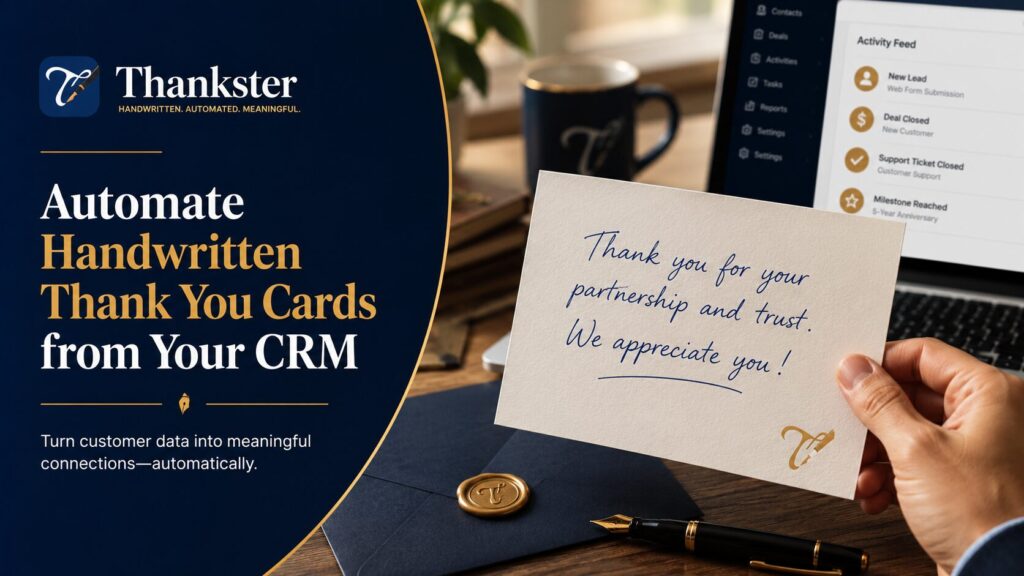
How to Automate Handwritten Thank You Cards from Your CRM with Thankster
Discover how Thankster integrates with your CRM to automate personalized handwritten thank you cards – strengthening customer relationships, boosting lead generation, and transforming routine follow-ups into meaningful human connections.
Keywords: automate handwritten thank you cards, CRM integration Thankster, personalized thank you card automation, Thankster Zapier CRM, handwritten card lead generation, CRM customer retention cards, Thankster Salesforce integration
The Lost Art of Gratitude in a Digital World
There is something quietly powerful about receiving a handwritten note in the mail. In an era dominated by automated email sequences, push notifications, and algorithmic messaging, a handwritten card carries a weight that no digital communication can replicate. It signals effort. It communicates care. It says, without ambiguity, that the sender considered the recipient as an individual – not as a data point in a pipeline.
Yet for businesses operating at scale, the idea of handwriting personal notes to every customer, lead, or contact feels impossibly impractical. How does a growing company reconcile the warmth of handwritten correspondence with the realities of modern operations? The answer lies at the intersection of automation and authenticity – and that intersection is precisely where Thankster operates.
Thankster is a platform built around a deceptively simple premise: automate the sending of personalized, handwritten thank you cards without sacrificing the genuine quality that makes those cards meaningful in the first place. When connected to a CRM system, the possibilities expand dramatically – turning customer data into thoughtful, timely gestures that strengthen relationships and drive real business outcomes.
Understanding the CRM-Thankster Connection
At its core, a CRM is a repository of relationship intelligence. It holds names, purchase histories, interaction timelines, preferences, support tickets, referral activity, and much more. Most businesses collect this data diligently but underutilize it when it comes to genuine human outreach. Thankster changes that dynamic entirely.
By integrating Thankster with a CRM, businesses can instruct the system to automatically trigger the creation and mailing of a personalized handwritten card whenever a specific event or condition is met. The CRM detects the event, passes the relevant customer data to Thankster, and Thankster generates and mails a card that feels entirely personal – because, in a meaningful sense, it is.
The integration works in several ways depending on the CRM in use. Thankster integrates directly with Infusionsoft (Keap) and connects with thousands of other platforms indirectly through Zapier, Make, Integrately, and similar platforms. This means that whether a business runs on Salesforce, Pipedrive, Zoho CRM, HoneyBook, Dubsado, Follow Up Boss, Close, Microsoft Dynamics 365 CRM, Zendesk Sell, Insightly, Copper, or dozens of other platforms, the automation pathway exists.
Consider what that means in practical terms. Imagine a business using Salesforce as its primary CRM. Through Zapier, Thankster can be triggered by a New Record, an Updated Field on Record, an Updated Record, or a New Outbound Message. Each of these triggers represents a moment in a customer’s journey – a moment that can now be met with a handwritten expression of appreciation rather than silence or a generic automated email.
Personalization That Feels Human Because It Is
One of the most critical distinctions in customer communication is the difference between personalization and genuine relevance. Many automated systems claim to personalize by inserting a first name into an email subject line. That kind of surface-level customization rarely moves anyone.
Thankster’s approach goes deeper. By drawing on the rich data already stored in a CRM – purchase history, milestones, preferences, support interactions – Thankster generates handwritten cards that include details genuinely relevant to the recipient. When a customer who just made a significant purchase receives a card that acknowledges that specific action, the experience is qualitatively different from a generic “thank you for your business” message. It communicates attentiveness. It demonstrates that the business noticed.
Picture this scenario: a customer reaches out to a company’s support team, files a complex ticket, and works patiently through several rounds of troubleshooting before the issue is resolved. A few days later, they receive a handwritten card expressing appreciation for their patience and cooperation. That single gesture has the potential to transform a frustrating experience into a memorable example of excellent service. The CRM detected the completion of the support ticket and automatically triggered Thankster to send the card – but the recipient experiences none of that machinery. They experience only the warmth of being acknowledged.
This is the quiet genius of well-executed automation: it creates the conditions for human connection to happen consistently, at scale, without requiring constant manual effort from the team delivering it.
Lead Generation Through the Power of Gratitude
While Thankster is widely recognized as a tool for customer retention and appreciation, its capacity for lead generation deserves equal attention. Gratitude, expressed at the right moment in a prospect’s journey, can be a remarkably effective catalyst for conversion and referral activity.
Lead Magnet Thank You Cards
When a potential lead signs up for a newsletter, downloads a free resource, or accesses any kind of lead magnet, they are making a small but meaningful gesture of interest. That moment is an ideal opportunity for reciprocal acknowledgment. Thankster can automatically send a personalized card expressing genuine appreciation for their engagement. The card can include a special offer, a call-to-action for the next step, or simply a warm note that sets a relationship in motion. In a landscape where most lead magnet follow-ups arrive as automated emails, a handwritten card arrives as something categorically different.
Referral Thank You Cards
Referrals are among the highest-quality leads a business can receive, and the people who provide them deserve meaningful acknowledgment. When a current customer or lead refers a new prospect, Thankster can automatically trigger a personalized thank you card to the referrer. This gesture not only expresses gratitude but also reinforces the behavior by making the referrer feel genuinely valued. When people feel appreciated for their advocacy, they tend to continue it.
Event and Webinar Follow-Up Cards
Trade shows, conferences, networking events, and webinars represent significant investments in lead development. After the event concludes, the quality of the follow-up often determines whether those investments translate into relationships. Sending a personalized handwritten card to contacts made at an event – one that references the interaction, expresses appreciation for their time, and invites a next step – creates a connection that a follow-up email rarely achieves. Thankster can automate this process so that every contact from an event receives timely, thoughtful outreach without requiring manual effort from the sales or marketing team.
Survey and Feedback Thank You Cards
When a lead or customer takes the time to complete a survey or provide feedback, they are offering something genuinely valuable: their perspective and attention. Acknowledging that contribution with a handwritten card – one that might include a discount code, an invitation to a demo, or simply a sincere expression of gratitude – transforms a transactional interaction into a relational one. These small moments of recognition accumulate over time into the kind of trust that drives conversion and loyalty.
Seamlessly Integrated Into Existing CRM Workflows
One of the most practical aspects of Thankster’s CRM integration is how naturally it fits into workflows that businesses already have in place. Rather than requiring a wholesale reimagining of existing processes, Thankster slots in as an additional output at key moments in the customer journey.
For businesses already using workflow automation within their CRM, adding a Thankster card-send step is a relatively straightforward extension. For those building automations through Zapier, Make, or Integrately, the flexibility is considerable. Lead generation tools, e-commerce platforms, event management systems, and social advertising platforms like Facebook Lead Ads can all serve as triggers that ultimately result in a handwritten card being generated and mailed by Thankster.
The range of CRMs available through these integration platforms is extensive. Among those accessible via Zapier, Make, and Integrately are Salesforce, Pipedrive, Wix Automations, Zoho CRM, Dubsado, Follow Up Boss, Close, kvCORE, Keap, Circle, NetHuntCRM, HoneyBook, Streak, Bark, Copper, Clio, Chime, Microsoft Dynamics 365 CRM, Zendesk Sell, Insightly, 17hats, and Kommo, among many others. This breadth of compatibility means that businesses across virtually every industry and operational model can find a pathway to automation.
Tracking, Analytics, and Continuous Improvement
Effective business communication is not only about what is sent – it is also about understanding what works. When Thankster is integrated with a CRM, businesses gain the ability to track and analyze the impact of their thank you card campaigns with genuine rigor. The CRM captures data on customer responses, subsequent interactions, and behavioral changes following card receipt. This information can then be used to refine strategies, identify the most impactful trigger points, and continuously improve the overall approach to customer engagement.
Imagine being able to identify, with reasonable confidence, which moments in the customer journey generate the strongest response to a handwritten card. That kind of insight transforms card-sending from an intuitive gesture into a measurable, optimizable component of customer retention and revenue strategy. The emotional resonance of a handwritten note and the analytical precision of data-driven marketing are not opposites – through thoughtful integration, they become complementary.
Practical Tips for Getting Started with CRM-Integrated Card Automation
For businesses considering implementing Thankster within their CRM ecosystem, a few guiding principles can make the difference between a well-executed program and a missed opportunity.
- Start with your highest-value trigger moments. Rather than attempting to send cards at every possible touchpoint immediately, identify the two or three moments in your customer journey where a personal acknowledgment would be most meaningful. A first purchase, a significant milestone, or a completed support interaction are natural starting points.
- Leverage your CRM data thoughtfully. The more relevant detail a card includes, the more powerful the experience. Ensure that the data fields you plan to use for personalization are consistently populated in your CRM before building the automation.
- Test before you scale. Run small-scale tests of your automation workflows before deploying them broadly. Confirm that the right data is being passed to Thankster, that card content reads naturally, and that timing feels appropriate to the trigger event.
- Align card content with the customer’s emotional state at that moment. A card sent after a frustrating support interaction should lead with empathy and appreciation for patience. A card sent after a first purchase should lead with enthusiasm and welcome. The emotional context of the trigger should shape the tone of the message.
- Incorporate clear next steps where appropriate. For lead generation use cases especially, a handwritten card can do double duty – expressing genuine appreciation while also including a meaningful call-to-action that moves the relationship forward. This should be done with subtlety; the dominant emotion should always be gratitude, with the call-to-action as a natural extension, not the primary message.
Why This Approach Matters Now More Than Ever
The business environment that companies operate in today is characterized by an extraordinary volume of automated, impersonal digital communication. Inboxes are saturated. Social feeds are cluttered. Consumers have become remarkably adept at filtering out messages that feel transactional or generic.
Against this backdrop, a handwritten card arriving in the physical mail is not simply a nostalgic gesture. It is a deliberate act of differentiation. It communicates, in a medium that carries inherent weight, that a business considers its customers and prospects as people worthy of individual attention. That signal, delivered consistently through intelligent automation, has the potential to meaningfully shift how a brand is perceived and how deeply customers commit to it over time.
Thankster’s CRM integration makes it possible for businesses to deliver this quality of communication at scale – not by replacing the human element, but by ensuring that the human element is expressed reliably, at the right moments, to every person who matters to the business. That is not a small thing. In a world where genuine connection is increasingly rare, the ability to create it consistently is a genuine competitive advantage.
Final Thoughts
Automating handwritten thank you cards through a CRM integration with Thankster represents one of those rare opportunities where operational efficiency and authentic human connection reinforce rather than undermine each other. The technology handles the logistics – the triggers, the data, the generation, the mailing. What arrives in the recipient’s hands is something that transcends the machinery: a tangible, personal expression of appreciation that carries real emotional weight.
For businesses investing in customer retention, lead generation, and long-term relationship building, this kind of thoughtful automation is not a luxury. It is increasingly a standard of care that customers notice when it is present – and notice when it is absent. Thankster makes it accessible, scalable, and genuinely effective.
The question is no longer whether handwritten gratitude can coexist with modern business operations. Through Thankster and its deep CRM integration capabilities, the answer to that question has already been answered. The more relevant question now is: which moment in your customer’s journey will you choose to make more meaningful first?