
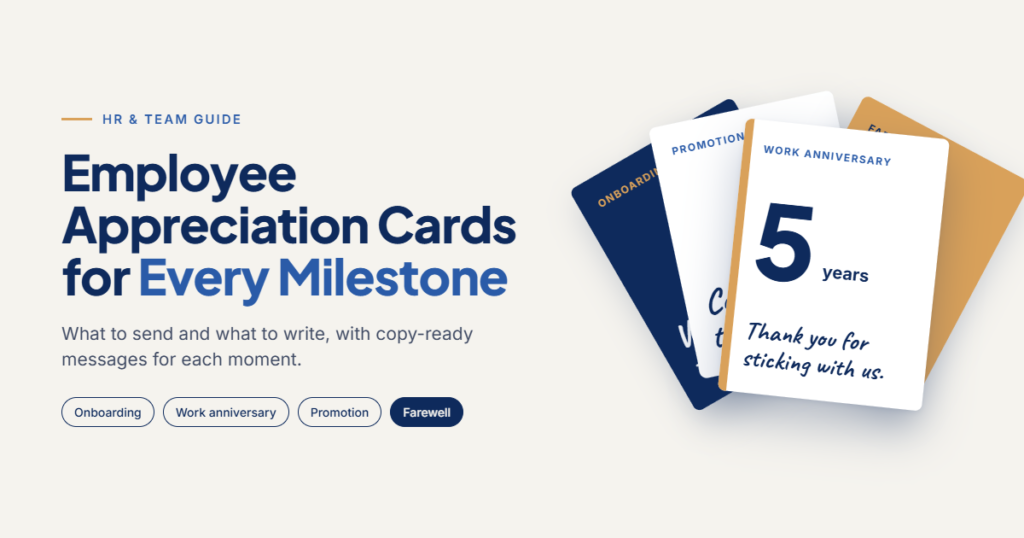
Employee appreciation cards work best when they arrive at the right moment with a message that speaks to that specific milestone. This post gives you copy-ready messages for four key moments: onboarding, work anniversaries, promotions, and farewells, along with practical guidance on format, timing, and how to send cards without it becoming a manual project.
Why Physical Cards Still Do the Work
People really like getting a card in the mail instead of an email. The physical card is nice to receive, and still reflects something personalized from the sender. For one thing, cards take up more room. The idea of sending physical cards is to offer a new way to touch people, one which breaks through the digital clutter.
For HR managers and founders running small teams, the challenge is consistency. Cards feel personal, but only if they actually go out. The sections below solve both problems: what to write and how to keep the sending on schedule.
Onboarding Cards
When to Send
Time a welcome card to arrive by the employee’s first day. Thankster always tries to print next business day, so if cards are mailed in the U.S., they should almost always arrive within a week, usually less. So it’s best to trigger orders a week before you want them to arrive, which provides a couple of days cushion.
What to Write
It’s generally best to keep the message as short and specific as possible. Mention something real about the role or the team. Avoid generic praise that could apply to any new hire anywhere. Be sure to take advantage of merge fields, which allow you to personalize the text for each person (for example, “Dear [first name],”).
Example message1 (small team, founder voice):
“You are joining at a great time. We’re glad that you’ve chosen to join us. With you coming aboard, the team we have in place will be well positioned to really make things happen.”
Example message 2 (HR department, warmer tone):
“First days come with a lot of information and not quite enough coffee. We want you to know the team is rooting for you. Welcome to [Company Name]. We are glad you are here.”
Example message 3 (remote employee, acknowledging distance):
“Even though we are not in the same office, you are fully part of this team from day one. We are excited to work alongside you.”
Format Tip
A new hire welcome would work best as a folder card, which goes inside an envelope. With a folder card, you can also put content on the other pages (images, QR codes, messages, handwriting, signatures, etc.). Note that there is no minimum requirement for Thankster’s folder cards, so you could send them one at a time as new hires arrive.
Work Anniversary Cards
When to Send
For anniversaries, we usually recommend adding a few extra days so the card gets there either early or on time. You would just need to import your employees as a list in Thankster, and then set up a recurring campaign that triggers automatically each year. You just add the anniversary dates and recipient info to it, so no milestone slips through the cracks.
What to Write
Mark the actual number of years. Generic “thanks for being here” messages feel less considered than ones that name the milestone. For longer anniversaries, a sentence about what has changed during that time adds real weight.
Example message 1 (one-year anniversary):
“One year in. You have already made a noticeable difference on the team, and we do not say that lightly. Thank you for the work you put in every week.”
Example message 2 (five-year anniversary):
“Five years is a significant chapter. The company looks different than it did when you started, and you are part of the reason why. Thank you for sticking with us through the changes.”
Example message 3 (ten-year anniversary):
“Ten years. That represents real commitment, and we do not take it for granted. The institutional knowledge you carry, the relationships you have built, and the standards you hold yourself to have shaped this team more than you probably realize.”
Promotion Cards
When to Send
Send a promotion card the week the promotion is announced or takes effect. Do not wait. A card that arrives three weeks later signals that it was an afterthought.
What to Write
Acknowledge the specific role they are moving into, not just the fact of promotion. If you can name a quality that led to the decision, the message becomes much more specific and memorable.
Example message 1 (individual contributor to manager):
“You earned this. The way you handle complex situations calmly and bring others along with you made this promotion an easy decision. Congratulations on your new role as [Title].”
Example message 2 (senior individual contributor, no direct reports):
“Stepping into a senior role means your judgment carries more weight, and that is exactly why we promoted you. Your expertise is an asset this team depends on. Congratulations.”
Example message 3 (cross-department move with promotion):
“A new team, a new title, and a new challenge. We are confident you will make the same kind of impact you made here. Congratulations, and thank you for everything you built in your previous role.”
Farewell Cards
When to Send
Order a farewell card as soon as you have a confirmed last day. You want the card to arrive before they leave, not after. If the person is remote, sending to a home address means you can still hit the timing even if you are not sharing a physical office.
What to Write
Farewell messages carry the most risk of feeling hollow. Avoid phrases like “best of luck” or “you will be missed” without backing them up with something specific. What did this person actually do? What will the team genuinely notice when they are gone?
Example message 1 (departing for a new opportunity):
“You are leaving to do something exciting, and that is worth celebrating. What you built here stays with us. Thank you for the energy, the ideas, and the standard you held yourself to. The next chapter is lucky to have you.”
Example message 2 (retirement):
“A career worth celebrating, and this is the moment. What you have contributed over the years has shaped people on this team in ways that will carry forward long after today. Enjoy every day of what comes next.”
Example message 3 (departing under difficult circumstances, neutral and kind):
“Whatever comes next, we are grateful for the time we worked together. We wish you well, and we mean that sincerely.”
Choosing the Right Card Format
| Milestone | Recommended format | Why |
|---|---|---|
| Onboarding | Folder card | Four pages for a note, signature, and QR code linking to resources |
| Work anniversary | Folder card | No minimum order; works for one employee at a time or automated batches |
| Promotion | Folder card or flat card | Flat card is clean and bold; folder card allows a longer message |
| Farewell | Folder card | Space for multiple signatories if you collect messages from the team |
How to Keep Card Sending Consistent
The biggest failure point with employee appreciation cards is not what to write. It is remembering to send them. Here is a simple system you can run through Thankster without manual reminders.
-
Upload your employee list as a CSV with start dates and birthdays.
-
You can set up recurring anniversary cards for your team. If you use a third party app, like a CRM, that app can also cause cards to trigger without you doing anything.
-
For onboarding and promotions, use one-off orders. You pay per card, at very affordable prices, and you can pre-pay for credit packs to get discounted pricing if you are strictly doing one-offs.
-
For farewells, build a saved template with your standard farewell message. When someone gives notice, you customize and send in a few minutes.
Cost Example for a Team of 20
If you send four milestone cards per employee per year (onboarding in year one, then one anniversary, one promotion opportunity, and one farewell over a typical tenure), you are sending roughly 20 to 30 cards per year for a team of 20. At the50-credit pack price of $2.38 per card, that is around $48 to $71 per year for all milestone cards across the team. That is a small budget for a consistent recognition program. If you get an integration plan card prices go as low as $1.79, plus postage.
Personalization Details That Make Cards Land Better
Thankster offers handwriting fonts that look very authentic because, among other things, the instances of each character vary. So a card won’t look like it came off a laser printer. You can add a signature by drawing one with the signature tool and your mouse or touch screen, or by inserting an image of it in the design editor using the image tool. You can add as many signatures as you want, so each manager on a team can sign cards with their own.
Generally the cards in a batch are all the same, or close, except for the greeting name or other merge fields. If you have a greeting of “Dear [first name]” in the message, it will use what is in the first name field, and the first names will be inserted for each recipient.
Request a free sample card at thankster.com to see how the handwriting-style printing and card stock look before you send your first employee milestone card.